Showing posts with label unit 6. Show all posts

Monday, December 13, 2010

Molar Mass Lab

On the 13th day of Christmas, we did a gas lab. In this Lab we had to find out how much hydrogen was made when Mg and HCl were combined. Heres the formula:


Mg + 2HCl -------> H2 + MgCl2
We then took some copper wire, wrapped it around the magnesium and dropped it in the HCl. This produces the H2 bubbles that collect in the top of the tube.


We measured how much gas was produced by using an instrument call a Eudiometer. That word just rolls off the tongue.Here is the Eudiometer.


Once we found the volume of the gas, we are then able to calculate how much H2 is in the measured volume by subtracting the H2O vapors from the total volume. We are also able to measure the pressure of the H2 using Dalton's Law of Partial Pressures.
If you missed the lab, you can find it here. Homework is to work on the Lab and Worksheets.
This has been Conor H. The next scribe will be Justin.

Friday, December 10, 2010

Nitrogen Ice Cream (and some other exciting stuff)


When have you ever gotten to say you were given ice cream in class? Better yet, when has your teacher actually made you ice cream out of nitrogen?
For those of us in 7th period Chemistry, we were able to experience both of the above.
But before we could get to our dessert making, we learned a lesson or two in chemistry.
We started off by having Bailey and Liebs switch identities. Liebs fell asleep on a fur-lined jacket, while Bailey taught the class how to do the pre lab.
Since you probably weren't paying attention to Bailey, I will review what she said.
For number 1, you need to find the partial pressure. So you do 746 mmHg (the total barometric pressure) and subtract 19.8 mmHg (the pressure of the water) to get 726.2 mmHg.
For number two, you use the answer from 1 and use the combined gas law to find V2.

For number 3, you take the .028 g of Mg given in the problem, and use stoich to convert it to moles of H2.
For number 4, you take the volume of the H2 and divide it by the moles you go in question 3. This is the molar volume of the hydrogen at STP.
Remember, the pre-lab is due Monday, so finish it up over the weekend if you haven't already.
Additionally in class, we talked about some new equations/forms of equations.
Since we know that g/mm is equivalent to number of moles, we can use substitution to get the following equation
PV=gRT/mm

Rearranging this equation, we can solve for density, since g/v=density
Pmm/RT=Density (g/v)

Additionally, we can solve for molar mass.
mm=DRT/P ("mm dirty pee")

Now we have 3 ways to get to moles.
  1. Pure substances-using molar mass
  2. Gases-using PV=nRT
  3. STP- 22.4 L/mole

We worked out two problems from the Gas stoichiometry packet.
Here is the work, in case you missed it.


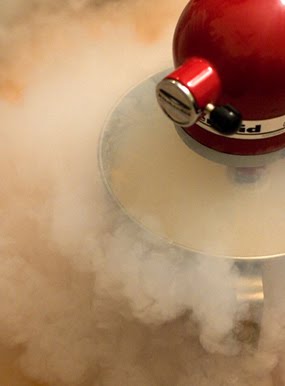
However, while all the above stuff is quite exciting, the most exciting part was when Liebs made us ice cream out of a few simple ingredients: hershey's syrup, milk/cream/half and half, sugar, and liquid nitrogen.

While we may've thought that this concoction was another one of Liebs' silly tricks, it is actually a recipe.
At first it looked like slimy goop, but as soon as the nitrogen worked its magic, we were all mesmerized by the result. We, in turn, were all given a generous portion of homemade chocolate ice cream, and it was quite tasty.
check out the video in the next post, i highly recommend watching it.

Homework: Webassign, pre-lab, worksheets.


The next scribe will be.........Conor.

Thursday, December 9, 2010

Nitrogen Party!!!

Today was a day that was filled with lots of nitrogen, in all three of its forms (including the rare solid nitrogen which few people have ever seen)! We started with some note-taking which you can get off moodle(not posted yet). The notes dealt with a new formula that is called the ideal gas law.

R= PV/NT (couldn't paste equations onto blogger from word)

R is the gas constant. It is equivalent to .082057. P is pressure (atm), V is volume(L), N is the number of moles, and T is temperature (K). This equation certainly is ideal for us because it relates all the variables into one law and we only need 1 circumstance rather than 2. For example, the combined gas law requires 2 circumstances. That is why you need 2 V's (V1 and V2) and so on. The combined gas law is below and it should be used when you have 2 circumstances.

P1V1/T1=P2V2/T2

With these two equations you can solve ideal gas problems which is on the worksheet you received today in class. After much convincing and pestering from the boys in row 1, they were able to convince Liebs to do at least one demo today. So Liebs took some of that awesome liquid nitrogen that he dumped on the floor yesterday, and threw it into the vacuum chamber that the balloon was in yesterday. Liebs lowered the pressure so much that the liquid nitrogen began to boil and finally it became solid. Though its appearance looked foamy, you'd never be able to feel it because once the pressure began to return to 1 atm, it quickly began to revert back to its liquid form. Finally, he dumped it onto the floor where it turned into a gas. That's all 3 forms of nitrogen. Somebody, though I can't remember who, coined the phrase nitrogen party. It certainly was!

Tonight's homework is the prelab for the Molar Volume lab and to do the ideal gas problem worksheet. The next scribe will be Rachel M.

"Life is like a garden: Dig it" ~A wise Man that is not Joe R

Wednesday, December 8, 2010

Pressure, Volume, Temperature, Number of moles!!


Another awesome day Honor chemistry 7th period!! oh yeah
Today we learned relationship between Pressure, Volume, Temperature, and Number of moles by looking at three formulas.
The first one was Boyles' Law

Therefore

As pressure increase volume decrease and when volume in crease pressure decrease.


a constant(k) stay same and pressure and volume are inversely proportional

The next formula was Charles' Law


As Temperature increase volume increase, so volume is directly proportional to temperature
o
B = a constant
Mr. Liebeman show a demo of this formula
He had two beakers and two balloons, and he heat one of them and put the other one into liquid nitrogen. As you can see in this picture the ballon on right side blowed up, because the temperature of air inside of ballon increase and it increase volume. On left side the ballon stuck inside of beaker, because this one was put in liquid nitrogen and cooled, so the air inside of beaker decrease volume.
The last formula was Avogadro's Law


a = a constant

Volume is directly proportional to the number of moles

Overall if we combined these formula to one formula


Whenever each one of value stay same we can cancel out

once again I really think 7th period Honors Chemistry is cooler than any other class haha

tonight's homework is Gas law sheet, and NEXT SCRIBE IS.......JOE R yeahhhh