Monday, November 15, 2010

Wednesday, November 10, 2010
Honors chem Goes viral
So today we started with a demo that was pretty awesome.
The reaction taking place was
Pb(No3) + KI
Pb(No3) + KI
This is lead nitrate and potassium Iodide
So back to what happened. the molecular formula for this reaction was PbI2(s) + KNO3
This is then balanced to Pb(No3) + 2KI --------> PBI2 + 2KNO3
The NIE was Pb^+2 + 2I- -------> PbI2(s)
That was pretty much our day after that we worked on the worksheet that can be found here and the lab which can be found here
Things you might want to know - Hali = ion form of a halogen
and there is a review sheet up here
After that we had some tough decisions to make because when our video goes viral we need a name and a mascot. We decided on Chris as our mascot ( the shirts we make will have his face on the back) and we havent came up with a good name, but we will. Tomorrow in class will be a review for the test on unit 4. Bring questions about the book problem,labs, worksheets and anything else about the unit.
Our next scribe is Sarah. Have fun.
Monday, November 8, 2010
Reactions, Reactions, Reactions
Today, after a long weekend of waiting, was the day of the "Double Replacement Reactions and Solubility Lab." We started out class talking about the lab procedure. After briefly discussing the post lab (questions 1 and 2 are now combined into one question, just write the Molecular Equation on one line and the Net Ionic Equation on another), we headed to the lab stations.

Our group first put a dropper-full of each sodium _____ in each respective row, and then added the various nitrates. The finished tray looked something along the lines of this: 
The combinations found to form precipitates for our group are as follows:
Sodium Carbonate + Aluminum Nitrate
Sodium Phosphate + Aluminum Nitrate
Sodium Phosphate + Barium Nitrate
Sodium Sulfate + Barium Nitrate
Sodium Carbonate + Copper(II)Nitrate
Sodium Hydroxide + Copper(II)Nitrate
Sodium Iodide + Copper(II)Nitrate
Sodium Phosphate + Copper(II)Nitrate
Sodium Carbonate + Iron(III)Nitrate
Sodium Hydroxide + Iron(III)Nitrate
Sodium Phosphate + Iron(III)Nitrate
Sodium Carbonate + Silver Nitrate
Sodium Chloride + Silver Nitrate
Sodium Hydroxide + Silver Nitrate
Sodium Iodide + Silver Nitrate
Sodium Phosphate + Silver Nitrate
Sodium Carbonate + Zinc Nitrate
Sodium Phosphate + ZInc Nitrate
Here is an example for one part of numbers 1 and 2 in the post-lab:
Molecular Equation: 3Na2CO3 +2Al(NO3)3 --> Al2(CO3)3+6NaNO3
Net Ionic Equation: 2Al^3+ +3 CO^3- -->Al2(CO3)3
You can tell which one is the solid based on the fact that sodium and nitrate salts are soluble in water...(the one that isn't NaNO3).
Homework for tonight:
The lab is due Friday
as are all the worksheets and book problems because...
the test is friday. Yay!
The only matter left to be settled is who will have the challenge of following this excellent scribe post. I believe his name starts with B and ends with -obby S.
Bobby S
Sunday, November 7, 2010
Ionic Equations Galore!
Friday's class was mostly a notes and independent work day. Mr. Lieberman started off by continuing his lecture about molecular and ionic equations.
The molecular equation is just another name for a balanced equation, which we learned how to do several classes ago. It's important that your molecular equation is written correctly before going any further, so make sure you pay attention that everything is correctly balanced. If not, the whole process afterward will be incorrect. Next, Mr. Lieberman introduced two new terms: complete ionic equations and net ionic equations. The complete ionic equation is the balanced equation with all the strong electrolytes written in as separate ions. So, for example, to make this molecular equation:
KCl + AgNO₃ ➝ KNO₃ + AgCl
into it's complete ionic equation, you would find out the electrical charge of each of the elements except for the precipitate. So, it would look like this:
K+ + Cl- + Ag+ +  ➝ AgCl + K+ +
 Every element shows it's electrical charge except AgCl since that is the precipitate [solid] formed. Lastly, Mr. Lieberman talked about a net ionic equation, which only includes the ions that undergo a change. That means that the spectators [ions that do not undergo a change] are not included. So, looking at the complete ionic equation above, the net ionic equation would be:
Cl- + Ag+ ➝ AgCl (s)
And that was basically all we did for the notes! After that, we had the rest of class to work on the Net Ionic Equation Worksheet. If you don't have it or have lost it, you can download it here and if you would like to check your answers, click here. Mr. Lieberman also mentioned that you should have done the Dissolving worksheet we got a couple days ago before attempting this one. The answers for that worksheet is here.
So that was Friday's class! Homework for Monday is the Chapter 4.2 Webassign and the Pre-Lab for the Double Replacement Reactions and Solubility Lab [to download, click here]. Also for the lab, make sure you create a data table! It's supposed to be a 6 x 8 grid with the rows and columns labeled with the anion solutions and cation solutions respectively.
Oh, and the scribe for Monday will be Declan G. Good luck! :]
Thursday, November 4, 2010
Solutions and Electrolytes
We began today's class by going over the answers to the Classifying Chemical Reactions post lab. In case you missed it:
Reaction 1: 2Mg + O2 ---> 2MgO
Synthesis
Reaction 2: 2HCl + Mg ---> MgCl2 + H2
Single Replacement
Reaction 3: (NH4)2CO3 ---> CO2 + 2NH3 + H20
Decomposition
Reaction 4: CaCO3 + 2HCl ---> CaCl2 + H2O + CO2
Double Replacement
Reaction 5: CuCl2 + Zn ---> ZnCl2 + Cu
Single Replacement
Reaction 6: 3CuCl2 + 2Na3PO4 ---> Cu3(PO4)2 + 6NaCl
Double Replacement
Reaction 7: NaOH + HCl ---> H2O + NaCl
Double Replacement
Next, Mr. Lieberman went over some new notes. We talked about solutions and electrolytes. A Solute is what is being dissolved in a substance (in this case we mainly focused on water). A Solvent is what is doing the dissolving. For example: You have water and salt. Water is the solvent and salt is the solute because it is being dissolved in the water. A solvent can be anything from a liquid, solid, or gas. Water dissociates ionic compounds into its ions (meaning that it takes them apart). Example: NaCl ---> Na+ + Cl-. Another example we used is the rock salt you pour on your driveway and sidewalks in the winter. The formula for it is CaCl2 but when it dissolves in the snow (water) you get Ca (charge of 2+) and 2Cl (charge is -).
If the compound happens to be covalent, the formula stays the same but changes whether it is a gas, solid, or liquid. For example: CO2 (g) ---> CO2 (aq).
Electrolytes are basically ionic compounds that carry a charge. Strong electrolytes are a solution containing enough ions to carry a current efficiently (complete ionization). A weak electrolyte is a compound that doesn't completely dissociate (small amount of ionization).
Electrolytes are essential to our lives. Without them we would die. Athletes drink gatorade because they want those electrolytes. Mr. Lieberman also brought up your nervous system. Neurotransmitters work as ions too. Your nervous system passes electrical currents all the time.
Mr. Lieberman conducted an experiment to show the presence of electrolytes. The goal was to light a lightbulb. At first this was attempted by placing a beaker of salt under the lightbulb where the metal ends were. The lightbulb did not light. Then the same thing was done with sugar. The bulb still did not light. Water was used next but the electrolytes were to weak to light the bulb. When adding a little salt to the water the electrolytes were strengthened and were able to light the bulb. When even more salt was added the electrolytes were even stronger and the light was brighter.
 |
| Strong Electrolytes |
 |
| No Electrolyte |
 |
| Weak Electrolytes |
That sums up today's class. We received a worksheet titled Dissolving that you should begin to complete. The unit test has been postponed to next friday. Hope everyone has a happy Thursday and a good night!!
The next scribe will be..................... Nicole C.
Good Luck! :)
Wednesday, November 3, 2010
chemical reaction notes and chemical reaction lab
This post is a combination of what happened in chemistry today and yesterday!
So on Tuesday we finished up the notes and started our classifying chemical reactions lab which we finished today.
There are five types of chemical reactions synthesis, decomposition, single replacement, double replacement, and combustion.
We finished talking about the last three:
3. Single replacement. This type of reaction occurs when there are three elements and one replaces another. Element + compoundà product + product. A + BCà AC + B (if A is a metal) or A + BCà BA + C (if A is a nonmetal).
4. Double replacement. This type of reaction occurs when a metal replaces a metal and a nonmetal and nonmetal. Compound + compound product + product. AB + CD à AD + CB.
5. Combustion. This type of reaction occurs when a hydrocarbon reacts with oxygen gas. In general CxHy + O2 à CO2 + H2O.
Then we did the classifying chemical reactions lab. For this lab you did a series of 7 reactions which each represented 4 out of the 5 reactions (everything but combustion).
So this is what you had to do and the observations me and my partner got:
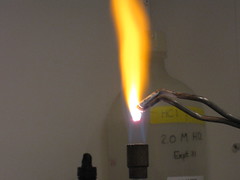
Reaction #1: You had to heat a piece of magnesium metal and let it light and then hold it over an evaporating dish. Our observations for this were, obviously, that the magnesium light up had a bright glow.
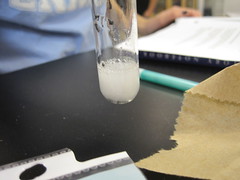
Reaction #2: for this you add hydrochloric acid to a small test tube and then add strip of Magnesium metal. Then you almost immediately light a wood splint and place it in the mouth of a test tube. For this we saw it fizz and make a POP! sound.
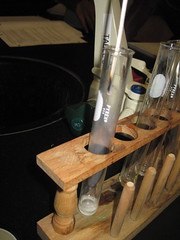
Reaction #3: for this you put a piece of ammonium carbonate in a test tube and heat it for 30 seconds. Then you piece of wet litmus paper in the mouth of the test tube and afterwards test the gas with a wood flint. For this we saw that the stick immediately went out after we put it in and the litmus paper turned blue very fast.
Reaction #4: For this reaction we put calcium carbonate in a test tube and added hydrochloric acid to it. Afterwards we light a wood splint and put the burning splint halfway down the test tube. Our observations for this were that there was no temperature change and the splint went out.
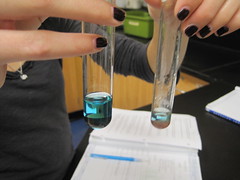
Reaction #5: For reaction five you had to add copper (II) chloride solution into a small test tube and add 1 piece of mossy zinc to the test tube. We observed that the mossy zinc instantly turned black.
Reaction #6: For this reaction you had to add copper (II) chloride to a small test tube and add sodium phosphate to that. Our observation for this was that the mixture precipitated and clumped.
Reaction #7: For the final reaction you add sodium hydroxide solution and phenolphthalein into a test tube and mix the solution. Then you add hydrochloric acid until there is a permanent color change. So as you can guess in this reaction we observed a color change. It went from a clear liquid to a pink liquid.

That was all for the lab and class! Tonight’s homework is to finish this lab, it’s due tomorrow.
The next scribe is ……….. Stephanie K.
Monday, November 1, 2010
Balancing Equations and Chemical Reactions
Today we began our discussion on the balancing of equations. One of the most important things to remember as you balance a chemical equation is the Law of Conservation of Mass, or in other words, what you start with you have to end up with. When dealing with an equation, you may only change the coefficients, NOT the subscripts. Two things you can do when balancing an equation is first: to start simplifying the atoms that only appear once in the formula, and second: to always balance and oxygen last.
There are five types of chemical reactions. The two we began discussing in class today were:
1. Synthesis reactions. These types of reactions occur when two substances (generally elements) combine and form a compound. Reactant + Reactant --> 1 product or A + B --> AB. An example of a synthesis reaction is 2 H2 + O2 --> 2 H2O
2. Decomposition reactions. This kind of reaction occurs when a compound breaks up into the elements or in a few to simpler compounds. 1 reactant --> product + product or AB --> A + B. An example of this type of reaction is 2 H2O --> 2 H2 + O2
In order to further explain these two reactions, Mr. Lieberman showed us two demonstrations.
http://www.youtube.com/watch?v=8ncN7AdROrY
The first video demonstrates a synthesis reaction. Liebs used a balloon filled with hydrogen gas and a candle as the two reactants. When the open flame touched the candle, it reacted violently with the hydrogen inside the balloon, causing the balloon to pop (although it was more of an explosion) and the product of the reaction was water.
The second video shows an example of a decomposition reaction. A large graduated cylinder was filled with hydrogen peroxide and some dish soap. When Liebs added the catalyst, the hydrogen peroxide reacted and foamed over the top of the graduated cylinder. Liebs calls this demonstration "elephant toothpaste."
http://www.youtube.com/watch?v=f_ftXxCwvDw
So that pretty much sums up what we learned in class today. Sorry everybody, my computer won't let me upload/embed the videos, so I just posted the web addresses to each of the videos. Hopefully they work.
Also, the next scribe is................. Nirali P.
Subscribe to:
Posts (Atom)