Wednesday, October 27, 2010

Magnesium Oxide Lab


First we went over the pre-lab. For number....
1. Subtract the massof iron (85.65 g) from the mass of the iron oxide produced (118.37)
2. Using molar mass, (O= 16 G) Set up the conversion, which should be the number of grams you found in number one, (Oxygen) multiplied by one mole of oxygen over 16 g
3. Using the same method, you should be able to find the moles of iron (molar mass= 55.9)
4. Next set up the ratio of moles, which should be number of moles of iron over moles of oxygen. You should end up with 3/4, so the empirical formula should then be Fe3O4

In the lab, here is what we did.
Using a crucible, we heated the magnesium oxide with the Bunsen burner.
Every three minutes, you take the lid off and allow oxygen to get in the crucible, sometimes you could even see the metal glow when this would happen. After heating for a while, and cooling, we massed out the magnesium oxide product. The mass should go up, since we were adding oxygen through the experiment.


Monday, October 25, 2010

Empirical Formula

Today in class we went over some of the notes and discussed the empirical formula.
Sample Problem: 71.65% Cl, 24.27% C, 4.07% H
1. assume 100 grams
a. 71.65 g.*(1 mol./35.5 g.)
b. 24.27 g.*(1 mol./12 g.)
c. 4.07 g. *(1 mol./1g.)

2. convert grams to moles
a. 2.02 mol.
b. 2.02 mol.
c. 4.07 mol.

3. calculate ratio
a. 2.02/2.02=1
b. 2.02/2.02=1
c. 4.07/2.02=2.01=about 2

4. empirical formula is CClH2

5. relate empirical formula to molecular formula (molar mass)
(49.5 g.)*2=
98.96 g/mol.

The next scribe will be Bailey Monte

Sunday, October 24, 2010

Hydrate Lab!

Today in class...

We started off by going over the quiz on Mole Conversions. For the rest of the class though, we did the Formula of a Hydrate Lab.

We started off by finding the mass of the empty test tube (to subtract it from the other masses later) and then the mass of the hydrate inside of the test tube

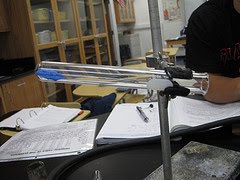
Next, we placed the test tube in the stand to heat it.

Then we began to heat the hydrate by using the Bunsen burner...

The blue hydrate eventually turned white, and it lost all of the water within it, the water left over towards the end of the tube can be seen below...


This new anhydrous salt was left, and we then had to find it's mass.


In the post lab, you should be able to use these masses to find moles of water lost during heating, the percent of water in the hydrate, the moles of anhydrous salt, and the ratio of moles of water lost per moles of anhydrous salt.

Thursday, October 21, 2010

Percent Composition

Today in class we learned about percent compositions and took our quiz on molar mass and unit conversions.

To start class today we talked about percent composition. Percent composition is used to describe the make up of a compound by mass percentage. It compares the mass of each element present in 1 mole to the total mass of the compound.

In our notes we did this sample problem:
Find the mass percent of each element in C14H20N2SO4.
14(12)+20(1)+2(14)+32+4(16)=312 (The numbers in the parenthesis are rounded versions of the atomic mass)
eq=\frac{14(12)}{312}=.538462

eq=\frac{20(1)}{312}=.64
This format is repeated for the rest of the components. The decimal answer you get is your mass percent.

% Composition of Bubble Gum


Yesterday in class we we began by briefly reviewing for our quiz which was pushed back until today. After our review of unit conversions and molar mass problems we began the Percent Composition of Bubble Gum Lab.

In this lab the purpose was to find out the percent sugar in bubble gum and write an empirical formula for bubble gum. The notes on empirical formulas will be displayed in a later post.

Here is the procedure for this lab:
1. Obtain a piece of bubble gum and its wrapper. Record the mass of the gum and its wrapper.

2. Unwrap the gum (save the wrapper). Chew the bubble gum. While Chewing the gum record the mass of the wrapper.

3. When the gum has lost its sweetness, place the chewed gum in the wrapper and record the mass of the gum and its wrapper.

Note: In this lab our class used Double Bubble chewing gum because as Mr. Lieberman said, "Double Bubble is the worlds greatest gum, for 15 seconds."

The calculations for this lab are due on Friday.

Tuesday, October 19, 2010

More Unit Conversions

Today we learned about conversions.

We started today looking at some more problems and explanations of molar mass and how to use it. Again molar mass is just the mass of 1 mole in grams. This is found on the periodic table and it is the atomic mass.
Look on the last post for examples of what the equations look like.

One of the most important things we learned today was that EVERYTHING must go through moles.

If it is Grams to Particles,it has to go through moles and if it is Particles to grams then it also has to got through moles.
We then did some learning checks problems like the Nutra-sweet problem. For problems like those to calculate the molar mass of something you take each element and treat it like its own part. For the Nutra- Sweet problem it would look like this
C14H18N2O5
(12x14) + (1x18) +(14x2)+(5x16). this is how you find the molar mass of a compound, then you complete the problem like a simple one.

After that we then had the rest of the class period to work with our partners on the Mole Workshop. Those problems are tricky they just need to be thought out and make sure to show your work. Remember that only one person in your pair needs to turn it in tomorrow but it is best if both partners do the work. I am sorry that I can not post the notes on here, I can not seem to find them on slideshare but if you have any questions just post it here or ask a teacher. This website http://www.chem1.com/acad/webtext/intro/MOL.html could also assist you.

Homework tonight: Finish the Mole Workshop and the other Mole worksheet
Study for the quiz tomorrow over dimensional analysis and unit conversions.
Test is coming up the 28th.

Alright well thats all I have have fun studying.
next scribe is Trevor. have fun

Bobby


I want a Number and Guacamole Named after Me

Hey sorry for the late post but this is for yesterdays.


To start of the day we went over the test we took on Friday and were told if we needed any help naming, the best thing to do was practice and more practice. After that we started looking at our notes about Avogadro's number. That number would be the mole. Is written in scientific notation as 6.02x10^23 or 602 billion trillion or 602,000,000,000,000,000,000,000. My recommendation is to keep it in scientific notation. The mole is only used when talking about Particles and molecules, things that are REALLY small. The mole is used in the same way that a dozen is used.

Ø 1 dozen cookies=12 cookies

Ø 1 mole of cookies=6.02x10^23

Ø 1 dozen cars=12 cars

Ø 1 mole of cars=6.02x10^23


The number will always be the same but the mass will be different. on a side note- mole is abbreviated as "mol" but in liebs class we feel that we deserve our own symbol that is shorter and more convenient so we chose a circle with a line through it. I would post the notes here but I can’t find them, they are not on slide share so I will just go on to conversions.

6.02x10^23/ 1 mol OR 1 mol/ 6.02x10^23 will always be used it depends on what you are trying to get. I will discuss which one to use in the section about general concepts below.
After we talked about Avogadro's number we went on to molar mass.

Molar mass is the mass of 1 mole in grams. This number is equal to the numerical value of the atomic mass found on the periodic table. For example:


Ø 1 mole of H atoms = 1.008g

Ø 1 mole of C atoms = 12.0g

Ø 1 mole of Bi atoms = 209.0g


As i am finishing up i will end with some general concepts to keep in mind when dealing with calculations involving moles


Ø For moles to particles, multiply by Avagadro's number (mole)

Ø For particles to moles, divide by Avagadro's number (mole)

Ø For grams to moles, divide by molar mass

Ø For moles to grams, multiply by molar mass


Well I am done for now - if you want to get a sense of how big a mole actually is you can check this out, http://www.youtube.com/watch?v=1R7NiIum2TI . This video is just showing how insanely big a mole is. Have fun

The next scribe is me. so until later tonight, have fun working on the worksheets we got and studying for the quiz tomorrow over conversions using moles and such and dimensional analysis.