Showing posts with label Declan G. Show all posts

Tuesday, March 15, 2011

Solution Formation Lab


In the shortened period today we did the Solution Formation Lab. The goal of the lab was to determine the effect of three variables on the solubility of copper sulfate in water. These variables were: crystal size, temperature, and degree of mixing. Based on my group's (Trevor B, Artie B, and myself...decide if you trust us or not) data, we came to the conclusion copper sulfate was most soluble under the following conditions:
  • higher temperature
  • smaller crystals
  • and vigorous stirring


Conversely, the least soluble conditions are:
  • lower temperature
  • larger crystals
  • and little to no stirring

And that's about it for today. Work on your Webassigns and the lab writeup is due Thursday. Until we meet again,
Declan G.

Joining you tomorrow will be the notorious Arthur B

Monday, November 8, 2010

Reactions, Reactions, Reactions

Today, after a long weekend of waiting, was the day of the "Double Replacement Reactions and Solubility Lab." We started out class talking about the lab procedure. After briefly discussing the post lab (questions 1 and 2 are now combined into one question, just write the Molecular Equation on one line and the Net Ionic Equation on another), we headed to the lab stations.

Our group first put a dropper-full of each sodium _____ in each respective row, and then added the various nitrates. The finished tray looked something along the lines of this: precipitate lab 021
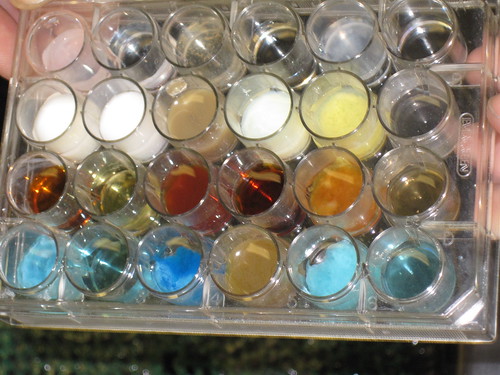
The combinations found to form precipitates for our group are as follows:
Sodium Carbonate + Aluminum Nitrate
Sodium Phosphate + Aluminum Nitrate
Sodium Phosphate + Barium Nitrate
Sodium Sulfate + Barium Nitrate
Sodium Carbonate + Copper(II)Nitrate
Sodium Hydroxide + Copper(II)Nitrate
Sodium Iodide + Copper(II)Nitrate
Sodium Phosphate + Copper(II)Nitrate
Sodium Carbonate + Iron(III)Nitrate
Sodium Hydroxide + Iron(III)Nitrate
Sodium Phosphate + Iron(III)Nitrate
Sodium Carbonate + Silver Nitrate
Sodium Chloride + Silver Nitrate
Sodium Hydroxide + Silver Nitrate
Sodium Iodide + Silver Nitrate
Sodium Phosphate + Silver Nitrate
Sodium Carbonate + Zinc Nitrate
Sodium Phosphate + ZInc Nitrate
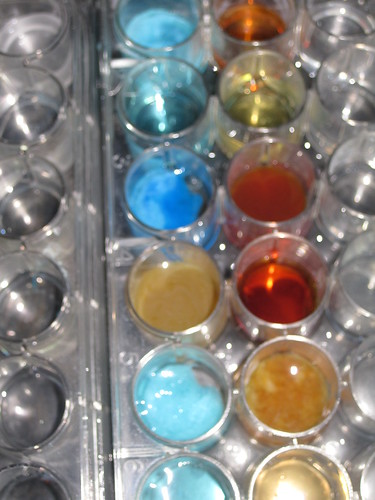
precipitate lab 017

Here is an example for one part of numbers 1 and 2 in the post-lab:
Molecular Equation: 3Na2CO3 +2Al(NO3)3 --> Al2(CO3)3+6NaNO3
Net Ionic Equation: 2Al^3+ +3 CO^3- -->Al2(CO3)3

You can tell which one is the solid based on the fact that sodium and nitrate salts are soluble in water...(the one that isn't NaNO3).

Homework for tonight:
The lab is due Friday
as are all the worksheets and book problems because...
the test is friday. Yay!

The only matter left to be settled is who will have the challenge of following this excellent scribe post. I believe his name starts with B and ends with -obby S.

Bobby S


Thursday, September 2, 2010

Separating Mixtures Lab Day One

Hey guys sorry for the late post I just got home from marching band. Anyways...
Today we started Day 1 of the Separating Mixtures Lab. Before heading to the back, however, we went over the pre-lab (which MUST include a pre-made data table!). We concluded that the best way to separate a mixture of salt, water, and sand would be to pass the solution through filter paper to catch the sand and collect the remaining salt water in a beaker. Then one would heat that beaker until the water evaporated, leaving the salt at the bottom of the beaker.

Mr. Lieberman then explained to us how mass percent works. For pre-lab question number two we found the answers to be 57.07% salt and 42.93% sand. This answer was reached by dividing the amount of tons of each substance by the total tons (when added together). For number three the answers were 171.875 pounds of flour and 103.125 pounds of sugar. This was achieved by multiplying the total (275 pounds) by .625 to get 171.875 and then subtract that from 275 to get 103.125. (Or you could use the algebraic way, but it is more difficult in my opinion.)

(Iron, salt, sand) (The filtering apparatus)


(The sand that couldnt pass through
the filter, now on a hot plate)

Mr. Lieberman then showed us all the materials we would be using for the lab were, and how to set up the filter paper. (Fold in half twice and then pull one "flap" to make a "pocket.")
Here is my data table from the lab...


Our homework tonight is to write out the procedure or steps for Part B of the lab, as well as finish the http://webassign.net/ . Mr. Lieberman won't be there tomorrow so we need to be on our best behavior for the sub. We will be finishing the lab. The next scribe is...Takashi I.