Showing posts with label Trevor B. Show all posts

Monday, March 7, 2011

Polarity

A polar molecule is caused caused when the difference in the electronegativity of an atom is between .4 and 1.7. If the difference is between 0 and .4 then the molecule is not polar. In a non-polar molecule the electrons are equally shared between the two atoms that are bonded together. in a polar molecule the electrons are unevenly shared between the atoms that are bonded together. In the bond one of the atoms tends to be negatively charged and the other tends to be positively charged.

One example of a molecule that is not polar is C-C. This molecule is non-polar because the difference in electronegativity of the two atoms is zero.

An example of a polar molecule is C-F. This molecule is polar because the difference in electronegativity is 1.43. Since it is polar the fluorine atom pulls harder on the electrons in the bond then the carbon and thus is partially negative while the carbon is partially positive. The electrons in this covalent bond are still being shared just not 50-50 between the two atoms.

The next scribe is.....Amar B.

Building the Big Ones

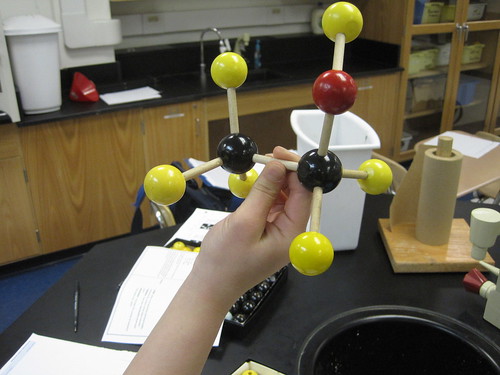
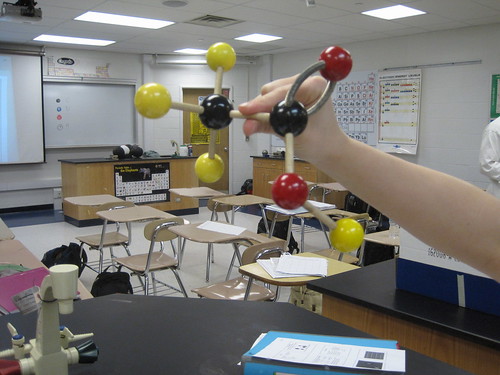
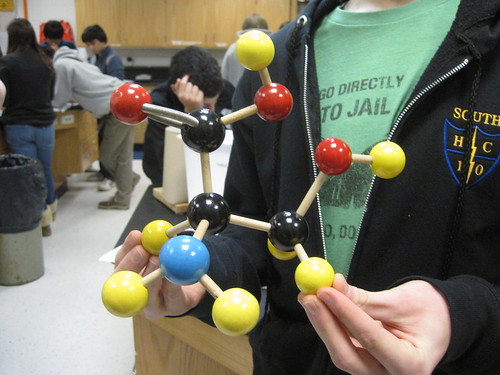
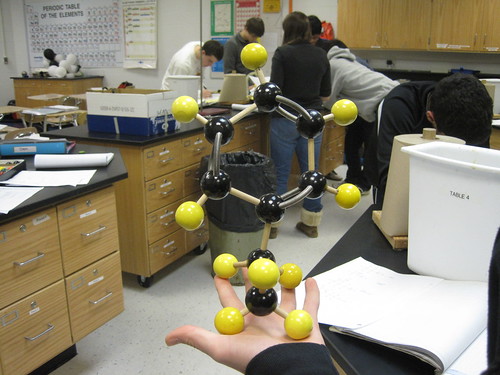
Today in class we did our first lab of the new unit. This lab was show students what a molecule with more then one central atom would look like. The molecules we had to build in the lab were, ethanol, acetic acid, serine, and styrene. Each molecule has a very unique shape to it and has many central atoms. In the pictures below black represents a carbon atom, yellow is hydrogen, red is oxygen, and blue is nitrogen.

This atom is ethanol and is comprised of two carbons, six hydrogens, and one oxygen, with the carbons and oxygen being the central atoms.


In this photo is the acetic acid molecule. It is made up of two carbons, four hydrogens, and two oxygens. In this molecule the carbons and one of the oxygens are the central atoms. Also in this molecule the metal springs connecting the carbon and oxygen atoms represent a double bond.


This molecule is serine. It has three carbons, seven hydrogens, three oxygens, and one nitrogen. The three carbons, two of the oxygens, and the hydrogen are the central atoms.

styrene

The final molecule is styrene. This molecule has eight carbons, and ten hydrogens. All eight of the carbons are central atoms.

Tuesday, November 30, 2010

Percent Yield


The theoretical yield is the amount of product that can be made in a complete reaction. The actual yield is the amount of product that is actually obtained in an experimental setting. For many reasons your actual yield will be lower than the theoretical yield, that is why we do a percent composition.
Here is a percent yield problem we did during class.
C12H22O11 -----> 11H2O + 12C

eq=70.0gC12H22O11x\frac{1\phi C12H22O11}{342g}x\frac{12\phi C}{1\phi C12H22O11}x\frac{12gC}{1\phi C}= 29.5g C

In class we ran this experiment and got a mass of 241.84 grams. From this value you must subtract the mass of the beaker, 155.20 grams, and the mass of the sulfuric acid, 59.06 grams. This leaves you with the mass of the carbon which is 27.58 grams.

Now to get the precent yield you use the formula at the top of the post.
eq=(\frac{27.58 g}{29.5 g})x100=93.5
Your final precent yield is 93.5%. I hope this will help you understand percent yields.
The next scribe will be... Chris A.

Thursday, October 21, 2010

Percent Composition

Today in class we learned about percent compositions and took our quiz on molar mass and unit conversions.

To start class today we talked about percent composition. Percent composition is used to describe the make up of a compound by mass percentage. It compares the mass of each element present in 1 mole to the total mass of the compound.

In our notes we did this sample problem:
Find the mass percent of each element in C14H20N2SO4.
14(12)+20(1)+2(14)+32+4(16)=312 (The numbers in the parenthesis are rounded versions of the atomic mass)
eq=\frac{14(12)}{312}=.538462

eq=\frac{20(1)}{312}=.64
This format is repeated for the rest of the components. The decimal answer you get is your mass percent.

% Composition of Bubble Gum


Yesterday in class we we began by briefly reviewing for our quiz which was pushed back until today. After our review of unit conversions and molar mass problems we began the Percent Composition of Bubble Gum Lab.

In this lab the purpose was to find out the percent sugar in bubble gum and write an empirical formula for bubble gum. The notes on empirical formulas will be displayed in a later post.

Here is the procedure for this lab:
1. Obtain a piece of bubble gum and its wrapper. Record the mass of the gum and its wrapper.

2. Unwrap the gum (save the wrapper). Chew the bubble gum. While Chewing the gum record the mass of the wrapper.

3. When the gum has lost its sweetness, place the chewed gum in the wrapper and record the mass of the gum and its wrapper.

Note: In this lab our class used Double Bubble chewing gum because as Mr. Lieberman said, "Double Bubble is the worlds greatest gum, for 15 seconds."

The calculations for this lab are due on Friday.