Showing posts with label Rachel M. Show all posts

Friday, December 10, 2010

Nitrogen Ice Cream (and some other exciting stuff)


When have you ever gotten to say you were given ice cream in class? Better yet, when has your teacher actually made you ice cream out of nitrogen?
For those of us in 7th period Chemistry, we were able to experience both of the above.
But before we could get to our dessert making, we learned a lesson or two in chemistry.
We started off by having Bailey and Liebs switch identities. Liebs fell asleep on a fur-lined jacket, while Bailey taught the class how to do the pre lab.
Since you probably weren't paying attention to Bailey, I will review what she said.
For number 1, you need to find the partial pressure. So you do 746 mmHg (the total barometric pressure) and subtract 19.8 mmHg (the pressure of the water) to get 726.2 mmHg.
For number two, you use the answer from 1 and use the combined gas law to find V2.

For number 3, you take the .028 g of Mg given in the problem, and use stoich to convert it to moles of H2.
For number 4, you take the volume of the H2 and divide it by the moles you go in question 3. This is the molar volume of the hydrogen at STP.
Remember, the pre-lab is due Monday, so finish it up over the weekend if you haven't already.
Additionally in class, we talked about some new equations/forms of equations.
Since we know that g/mm is equivalent to number of moles, we can use substitution to get the following equation
PV=gRT/mm

Rearranging this equation, we can solve for density, since g/v=density
Pmm/RT=Density (g/v)

Additionally, we can solve for molar mass.
mm=DRT/P ("mm dirty pee")

Now we have 3 ways to get to moles.
  1. Pure substances-using molar mass
  2. Gases-using PV=nRT
  3. STP- 22.4 L/mole

We worked out two problems from the Gas stoichiometry packet.
Here is the work, in case you missed it.


However, while all the above stuff is quite exciting, the most exciting part was when Liebs made us ice cream out of a few simple ingredients: hershey's syrup, milk/cream/half and half, sugar, and liquid nitrogen.
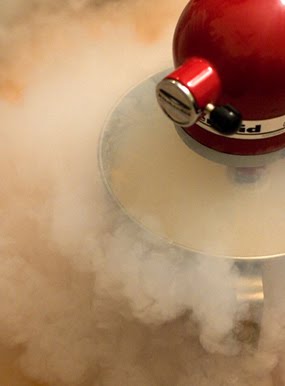
While we may've thought that this concoction was another one of Liebs' silly tricks, it is actually a recipe.
At first it looked like slimy goop, but as soon as the nitrogen worked its magic, we were all mesmerized by the result. We, in turn, were all given a generous portion of homemade chocolate ice cream, and it was quite tasty.
check out the video in the next post, i highly recommend watching it.

Homework: Webassign, pre-lab, worksheets.


The next scribe will be.........Conor.

Thursday, September 9, 2010

Chemical Reaction Lab


At the beginning of yesterday's class we turned in our separating mixtures lab. Then we proceeded to our lab desks to complete our chemical reaction lab. We had started Part A yesterday, but I'll give a brief summary of part A just to review. We used a Bearal-pipet to fill 6 rows of the well plate with HCl. We were to record both temperature of the HCl and the initial appearance in our data table. This was helpful because after the experiment was over, we could look compare the before and after data.


PART A:

  • The first well we tested was A1. Groups were to put a piece of blue litmus paper in the HCl and record their initial observations, including appearance and temperature change. Next, we added 1 mL of sodium hydroxide solution and noted any temperature change. We waited a minute and tested the solution again with a piece of litmus paper. This was to test the pH of HCl, and to see if the pH would change because of the sodium hydroxide solution.
  • Next, well A2. Groups added solid sodium bicarbonate to the HCl, and were to observe all changes including temperature. Once the reaction had settled down, groups were to add 2 more portions of sodium bicarbonate.
  • For well A3 groups were to use a Beral-type pipet to add 1 mL of silver nitrate solution. Again, we used the date table to record observations.
  • For well A4, groups added a small piece of mossy zinc to the HCl and recorded observations.
  • For well A5, groups were to use the forceps to add one piece of aluminum to well A5, and accord observations in the data table.
  • Lastly, well A6. In A6 we added one piece of magnesium ribbon, and recorded our observations.
  • After part A was completed, groups were to remove unreacted metals from well A4-A6 and rinse the metals with water and throw away.
  • Picture shows the general setup for the wells.

This is the data that I collected for the temperature/appearance changes in Part A.
(sorry if you cant read it)


PART B:
  • Part B was pretty similar to part A, except with cupric chloride instead of HCl.
  • To start off, we added 1 mL of cupric chloride to well B1-B6.
  • Next we placed various items into each well and recorded all observations.
  • For well B1-one piece of aluminum shot was added, B2-aluminum foil, B3-zinc, B4-1 mL ammonium hydroxide solution, B5-1 mL sodium carbonate solution, B6- 1 mL silver nitrate solution.
  • After that, we used forcepes to remove any pieces of unreacted metals from well A4-A6, rinse the metals with water, and dispose.
  • Picture on right shows how some of the metals corroded because of the cupric chloride


Here is my data table for Part B. Sorry again if you can't read it.


PART C:

  • In Part C we used a graduated cylinder to add 10 mL of cupric chloride into a flask.
  • Next, we rinsed the graduated cylinder and added 3 mL of silver nitrate solution to a small test tube.
  • After that, we placed the test tube in the flask, capped the flask with a rubber stopper, and recorded the mass.
  • We inverted the flask several times so the contents of the flask and test tube would mix. We measured the mass again and recorded it.
  • The two masses should be the same.

Here are some things you might want to take a look at:

Tonight's homework:
  1. Study for tomorrows quiz (previous webassigns, chemthink, worksheets, notes, labs etc.)
  2. Complete the lab
The next scribe is Stephanie K.

-Rachel M